
ESG & Sustainability
Enviroment, Social and Governance
An ESG solution that enhances your initiative management
ESG solution that facilitates the organization's transformation towards a sustainable future by providing an overview, ensuring complete documentation, and enabling extensive reporting.
Create An Effective ESG Process
Tracking data and processes manually across departments in Excel and Word can quickly become unmanageable. It is inefficient and time-consuming.
With RISMA's ESG solution, you get help to structure processes and policies to effectively manage and control all ESG initiatives across the organization in an integrated solution. Set clear goals, track progress, and easily turn your sustainability strategy into action.
Risk management
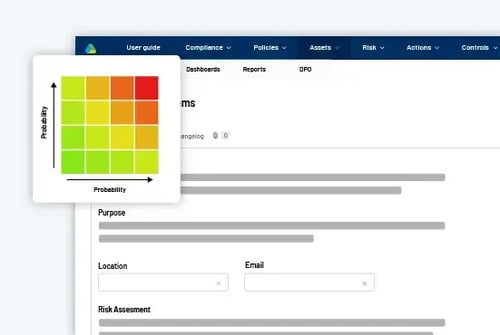
Define, assess and analyze ESG risks and use your insights to make informed decisions about the company's approach.

Unify your risk management across the organization.
Get an overview of the overall risk landscape and plan your efforts
Set guidelines and delegate risk follow-ups across departments
Streamlined controls and action plans
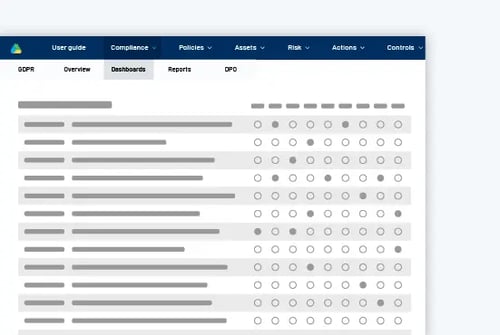
Reduce manual work by automating recurring controls. Thereby removing inefficiency and risk of errors.
Structure and manage the progress of your ESG initiatives
Create annual wheels with automated controls
Carry out ESG audits of the value chain - scope 2 and 3
Easy documentation and reporting
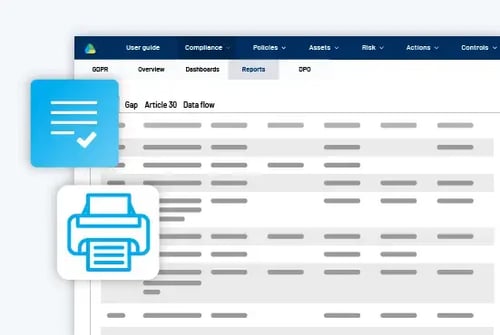
With quick access to documentation and reports, you get an easy overview, so you know exactly what activities have been carried out, what the status is, and what is missing.
Easy access to documentation of sustainability factors
Automate the foundation of your sustainability report
Document the ESG efforts to relevant stakeholders
Reduce manual processes and achieve greater transparency and efficiency
Everything you need in an ESG solution.

From strategy to action
Once sustainability and the UN's global goals are placed on the agenda, the strategy must be translated into action and integrated into the organization's value chain, as well as anchored across countries and departments.
RISMA's ESG solution helps to create coherence between all the efforts and areas that the ESG compliance requires.

RISMA ESG creates coherence

Sustainability reports
Policies and procedures
Goals and commitments
The value chain scope 1, 2 and 3
Delegation and anchoring
Controls and action plans
Ongoing internal and external reporting
Documentation of progress on objectives
The building bricks of the ESG solution


Seamless Implementation
Our ESG compliance solution is developed with an intuitive user interface, making it is easy to work with.
To get the best possible start, our Customer Success team is ready to help your organization get started with a well-organized process. You also have the possibility of receiving ongoing support, so you get the most out of using our solution.

Let us help you systemize your ESG compliance for greater results.
We help more than +500 mid sized organizations succeed with their compliance initiatives and we would love to help you.

A GRC Platform to bring the organization together
Power your organisation by connecting data, teams, action and reporting in an integrated GRC platform. Whether you deploy one, two, or all our solutions, RISMA GRC platform provides great value by boosting collaboration, increasing visibility, and saving time for everyone involved..
-

Internal audit streamlined
-
Effortlessly automate, document and report all your controls - including assessment, mitigation and monitoring in one simple platform.
-
Risk management organized
-
Define, assess, analyze and mitigate your organization’s risks and turn your insight into strategic assets.
-

GDPR compliance unified
-
Manage compliance frameworks, controls, risks, policies, and reporting in one integrated solution.
FAQ
Why is it important to work with ESG?

ESG is an increasingly central part of organizations' operations and competitiveness. Partly, because ESG optimization is becoming a legal requirement for many organizations as a result of EU legislation, including CSRD. Partly, because ESG strengthens risk and value management by providing insight into potential environmental, social, and governance challenges.
ESG is also closely connected to an organization's strategic opportunities. A strong focus on ESG can be pivotal in attracting capital, forging partnerships, and tapping into new markets. At the same time, customers and investors are demanding greater transparency and proven accountability across the entire value chain, making ESG a key driver of trust, brand strength, and long-term competitiveness.
When is ESG a demand?
Working with ESG is becoming an increasingly important focus for European businesses. With the implementation of CSRD, specific requirements for ESG reporting are now in place for certain types of companies. According to the original timeline, CSRD reporting was initially planned in over three stages.
- 2024 (reporting in 2025): Large listed companies (over 500 employees.
- 2025 (reporting in 2026): Large companies meeting at least two out of three criteria (more than 250 employees, €50 million in net revenue, or a balance sheet total exceeding €25 million).
- 2026 (reporting in 2027):
In February 2024, the European Commission introduced the Omnibus proposal to reduce and simplify the administrative burdens for companies. The reporting obligation has been postponed, and companies originally scheduled to report for the financial years 2025 or 2026 will now only need to report from the financial year starting January 1st, 2027, or later. The European Parliament has further reduced reporting obligations and due diligence requirements, meaning only companies with an average of over 1,750 employees and an annual net turnover exceeding €450 million will be required to prepare social and environmental reports. Only companies within this category will also be required to prepare sustainability reports in accordance with the taxonomy rules. Additionally, due diligence requirements will only apply to large companies with over 5,000 employees and an annual net turnover exceeding €1.5 billion.
What do CSRD and VSME mean for companies' ESG efforts?
Today, companies' ESG efforts are supported by a range of regulations. These regulations impact businesses' sustainability work by introducing new reporting requirements and opportunities. One example is the CSRD, which establishes how certain companies in the EU must report on ESG matters in accordance with the ESRS standards. Another example is the VSME, a voluntary standard aimed at small and medium-sized enterprises. While these businesses are not directly subject to the CSRD, they may still be affected by requirements from their customers who demand sustainable suppliers.
With CSRD and VSME, companies gain a common and standardized foundation for sustainability reporting, which makes ESG work an increasingly integrated part of business operations.
How are the different sustainability modules connected in RISMA?
The different sustainability modules in RISMA are designed to support your work with CSRD and VSME compliance, as well as ESG reporting. The modules can be integrated into a unified GRC platform, helping you structure, manage, and document your ESG efforts effectively and transparently. With ESG software, you can centralize your processes and data across the organization, allowing it to be used and shared by various departments.
RISMA can be used to meet the reporting requirements of the CSRD, as well as to support smaller businesses opting to work with the voluntary VSME standard. This way, both large and small companies can establish a strong foundation for sustainability reporting.
The modules are interconnected across four key areas:
- Risk management
- Policies and controls
- Reporting and documentation
- Task Management and collaboration
RISMA organizes and systematizes ESG reporting, making compliance work more manageable and easier to document.